


English is spoken all over the world, but two of its most influential varieties are British English and American English. While they are mutually understandable, they differ in vocabulary, spelling, pronunciation, and even grammar. Understanding these differences can help learners communicate more confidently and avoid confusion.
Below are 40 key differences between British and American English, organized for easy learning.
1. Vocabulary Differences
Many everyday words are completely different in British and American English.
Flat (UK) – Apartment (US)
Lift (UK) – Elevator (US)
Petrol (UK) – Gasoline / Gas (US)
Lorry (UK) – Truck (US)
Biscuit (UK) – Cookie (US)
Chips (UK) – French fries (US)
Crisps (UK) – Chips (US)
Holiday (UK) – Vacation (US)
Queue (UK) – Line (US)
Rubbish (UK) – Trash / Garbage (US)
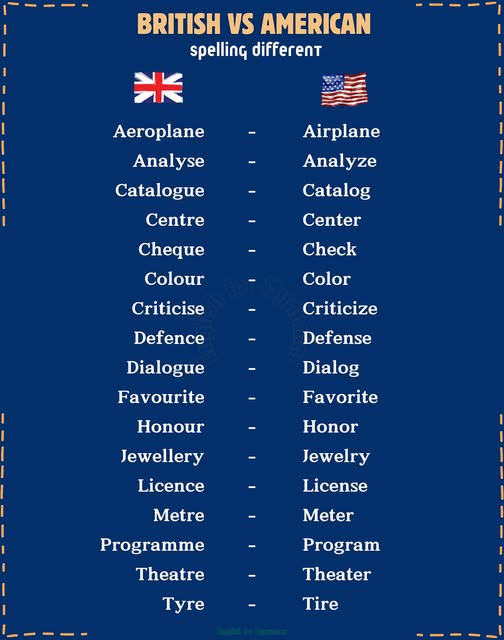
2. Spelling Differences
American English often uses simplified spellings.
Colour (UK) – Color (US)
Centre (UK) – Center (US)
Travelling (UK) – Traveling (US)
Organise (UK) – Organize (US)
Programme (UK) – Program (US)
Defence (UK) – Defense (US)
Cheque (UK) – Check (US)
Tyre (UK) – Tire (US)
Licence (UK) – License (US)
Jewellery (UK) – Jewelry (US)
3. Pronunciation Differences
Pronunciation can vary noticeably between the two varieties.
Schedule – /ˈʃedjuːl/ (UK) vs /ˈskedʒuːl/ (US)
Advertisement – ad-VER-tis-ment (UK) vs AD-ver-tize-ment (US)
Tomato – to-MAH-to (UK) vs to-MAY-to (US)
Garage – GA-ridge (UK) vs guh-RAZH (US)
Herb – pronounced with “h” (UK) vs silent “h” (US)
4. Grammar Differences
There are also small but important grammar differences.
Present perfect usage
UK: I have just eaten.
US: I just ate.
Collective nouns
UK: The team are winning.
US: The team is winning.
Past tense forms
UK: learnt, dreamt
US: learned, dreamed
Prepositions
UK: at the weekend
US: on the weekend
Got vs. gotten
UK: I’ve got better.
US: I’ve gotten better.
5. Everyday Expressions & Usage
Some common expressions differ in daily conversation.
Post (UK) – Mail (US)
Postbox (UK) – Mailbox (US)
Chemist (UK) – Drugstore / Pharmacy (US)
Public school (UK) – Private school (US)
Football (UK) – Soccer (US)
6. Transportation & Daily Life
Underground (UK) – Subway (US)
Return ticket (UK) – Round-trip ticket (US)
Motorway (UK) – Freeway / Highway (US)
Zebra crossing (UK) – Crosswalk (US)
Toilet (UK) – Restroom / Bathroom (US)
Conclusion
British and American English share the same roots, but their differences reflect unique cultural and historical developments. For English learners, the key is consistency—choose one variety for writing and formal learning, while staying aware of the other for listening and communication.
Whether you prefer British or American English, understanding these 40 differences will make your English clearer, more natural, and more confident.