Download a list of linking words and phrases in pdf
Linking words and phrases are essential components in both English writing and speaking. They facilitate the smooth connection of ideas, sentences, and paragraphs, enabling readers to comprehend the writer’s thoughts without any confusion.
Regardless of whether you are a student, educator, or professional writer, mastering the correct usage of linking words can greatly enhance the clarity and coherence of your communication.
What Are Linking Words and Phrases?
Linking words and phrases, often referred to as connectors or transition words, serve the purpose of joining ideas and illustrating the relationships between them.
These relationships can encompass addition, contrast, cause and effect, comparison, or sequence. By employing these connectors, writers can effectively guide readers through their arguments in a logical and structured manner.
For instance, in the sentence “I wanted to go for a walk; however, it started raining,” the term ‘however’ indicates a contrast between the two ideas.
Types of Linking Words and Phrases
There are various categories of linking words, each designed to fulfill a specific function:
1. Addition
These words serve to introduce additional information or ideas. Common examples include ‘and,’ ‘also,’ ‘moreover,’ ‘furthermore,’ and ‘in addition.’
Example: She is both intelligent and hardworking.
2. Contrast
Contrast connectors emphasize the differences between ideas. Examples include ‘but,’ ‘however,’ ‘although,’ ‘whereas,’ and ‘on the other hand.’
Example: The task was challenging; however, it was worth the effort.
3. Cause and Effect
These linking words clarify reasons and outcomes. Common examples include ‘because,’ ‘so,’ ‘therefore,’ ‘as a result,’ and ‘due to.’
Example: He studied diligently; therefore, he succeeded in the exam.
4. Sequence and Order
These words indicate the sequence of events or ideas, such as ‘first,’ ‘next,’ ‘then,’ ‘finally,’ and ‘meanwhile.’
Example: First, gather the materials. Then, commence the experiment.
5. Comparison
Comparison connectors highlight similarities or differences, including ‘similarly,’ ‘likewise,’ ‘in the same way,’ and ‘compared to.’
Example: Similarly, online education provides flexibility.
Why Are Linking Words Important?
Linking words and phrases enhance the coherence of writing by preventing sentences from appearing isolated or abrupt.
They assist in organizing thoughts, reinforcing arguments, and making the writing more captivating.
In the absence of linking words, writing may seem disjointed, complicating the reader’s ability to grasp the intended message.
In academic writing, linking words hold particular significance as they showcase logical reasoning and structured argumentation.
In casual communication, they contribute to a more natural and fluent speech.
Tips for Effectively Utilizing Linking Words
To utilize linking words effectively, refrain from excessive use, as this may render the writing repetitive.
Select connectors that accurately represent the relationship between concepts.
Additionally, diversify your linking words to maintain the interest and dynamism of your writing.
Conclusion
Linking words and phrases are vital instruments for effective communication.
They facilitate smooth transitions, elucidate relationships between ideas, and improve overall readability.
By mastering these connectors, writers can convey their thoughts more clearly, logically, and confidently in both spoken and written English.
What are Linking Words and Phrases

Table of Contents
Addition
- and
- also
- and also
- not only … but also
- and … as well
- as well as
- in addition
- additionally
- moreover
- furthermore
- besides
- besides to this
- what is more
- too
- apart from
- additionally
- coupled with
- not to mention
- to say nothing of
- together with
- along with
Examples:
- I bought a dress and a shawl. (joining two items; no commas used)
- She was hungry and sleepy. (joining two adjectives)
- The children sang and danced. (joining two verbs)
- I bought a dress, a shawl and a bag. (joining more than two items; commas used to separate the items; in British English no comma before and; in American English we add a comma before and)
- They cooked the dinner, and they cleaned the kitchen. (joining related ideas-complete sentences; separated with a comma)
- We discussed the job benefits, such as health insurance, overtime, annual leaves, and so on. (= in addition to other things of the same kind; and so forth)
- Not only is the house economical, but it is also convenient. (When not only is at the beginning of the sentence, we invert (reverse) the order of the subject and verb.)
- The new book is well-written; moreover, it has effective illustrations.
- The car was beautiful. Furthermore, it was easy to drive.
- We can’t go now because my mother doesn’t feel well. Besides, I have an important task to finish urgently.
- I don’t think we will need such a big car, not to mention the price.
- Along with her university studies, she had a part-time job.
- His father was unhappy with his results. His mother was frustrated, too.
Explanation / Illustration
- in other words
- for one thing
- to put it differently
- as an illustration
- that is to say
- namely
- for example
- for instance
- to illustrate
- to clarify
- to explain
- to demonstrate
- to emphasize
- to numerate
- such as
- including
- like
- in detail
Examples:
- The teacher asked me to rewrite the essay. In other words, she didn’t like it.
- You can never rely on him. For example, he doesn’t finish his work on time. (For example introduces a sentence: Subject-Verb.)
- They made a number of improvements on the new machine. The wash cycle, for instance, is shorter now. (For instance introduces a sentence: Subject-Verb.)
- In addition to English, her son speaks several languages, such as Arabic, Spanish, and French. (Use a comma before such as.)
- In our company, there are many workers from Asian countries like China, Japan and Malaysia.
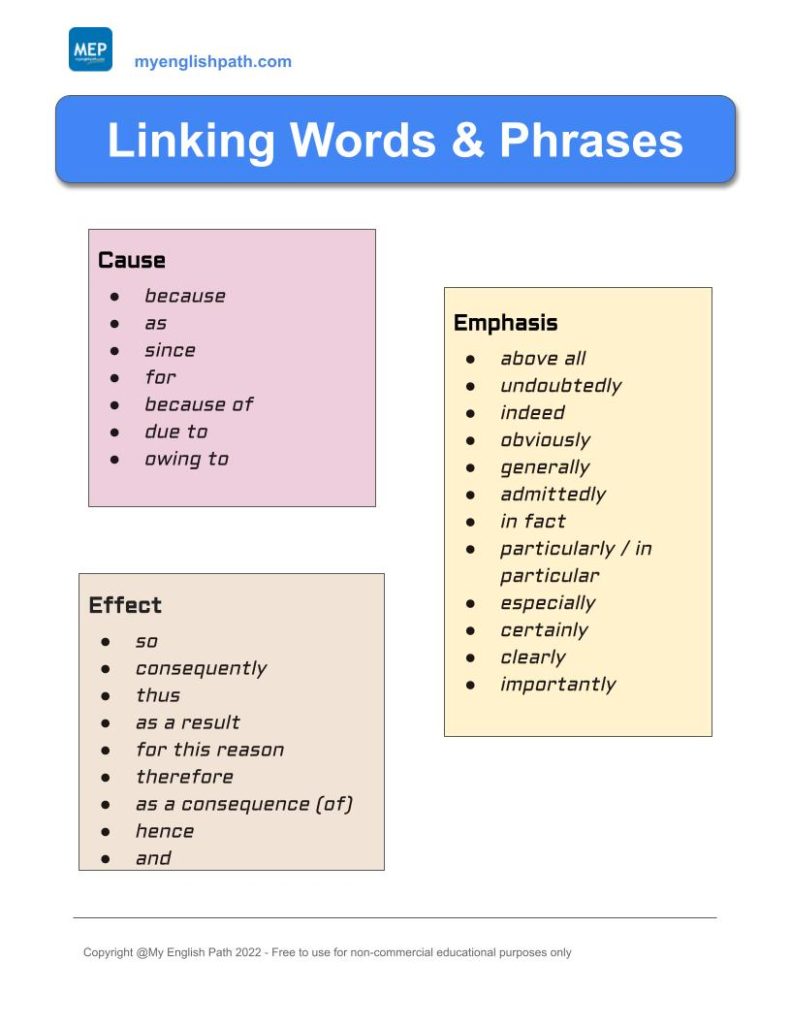
Cause
- because
- as
- since
- for
- because of
- due to
- owing to
Examples:
- The meeting was cancelled because the reports were not ready. (followed by Subject-Verb)
- As he was the oldest, he opened the session.
- They won’t be able to come with us since they are busy with their exams.
- She didn’t say anything, for she was upset about the news.
- Our flight was delayed because of the sand storm. (followed by a noun phrase)
- Our flight was delayed due to the sand storm.
Effect
- so
- consequently
- thus
- as a result
- for this reason
- therefore
- as a consequence (of)
- hence
- and
Examples:
- She felt pain in her heart, so she stopped running.
- It rained a lot during the past few days. Consequently, the reservoirs are full.
- They worked all day and thus they are exhausted now.
- We were well-prepared for the change. As a result, it did not have a big impact on our work system.
- He had a lot of trouble with his neighbors. Therefore, he moved to another house.
- The disease spread rapidly in the city. As a consequence, a lock-down was imposed.
- She’s got a pay rise, hence the new phone.
- Read her message and you will understand what she wants. (= so; as a result; in order to)
- You may go and see what they’re doing. (= so; as a result; in order to)
Emphasis
- above all
- undoubtedly
- indeed
- obviously
- generally
- admittedly
- in fact
- particularly / in particular
- especially
- certainly
- clearly
- importantly
- She was above all a good and tireless teacher.
- Undoubtedly, regular exercise has a big impact on our health.
- In fact, his long experience helped him get the job.
- We love cold drinks, especially in summer.
- Certainly, financial factors escalated the problem.
- Importantly, getting a university degree opened many doors for him.
Similarity
- similarly
- likewise
- also
- like
- just as
- just like
- similar to
- same as
- compare
- compared to
Examples:
- They were brought to be polite. Similarly, they’re trying to teach their children good manners.
- The book was very exciting. Likewise, the details added in the movie were enjoyable.
- The goods offered at this store are similar to the ones we saw online.
- His works compare with his father’s works. (They are similar)
- Compared to young trees, children are still growing and can be shaped.
Contrast
- however / nevertheless / nonetheless / notwithstanding
- but / yet
- although / though / even though
- despite / in spite of
- despite the fact that / in spite of the fact that
- in contrast (to) / in comparison
- while / whereas
- on the other hand
- on the contrary
- different from
- conversely
- unlike
- compared with
Examples:
- The salary was very high. However, he refused the job.
- I went to work even though I wasn’t feeling well.
- He managed to complete the game despite hurting his foot.
- I enjoyed the book in spite of the fact that the story was boring.
- They aren’t close friends, but they can work very well together.
- One of the children was sleeping, while the other was coloring.
- In contrast to his brother, he is very tall.
- I don’t think the portrait is ugly. On the contrary, I believe it is beautiful and expressive.
- We had to prepare for the meeting. On the other hand, we were asked to receive an important guest at the airport.
- My schedule on Sundays and Mondays is very busy compared with the rest of the week.
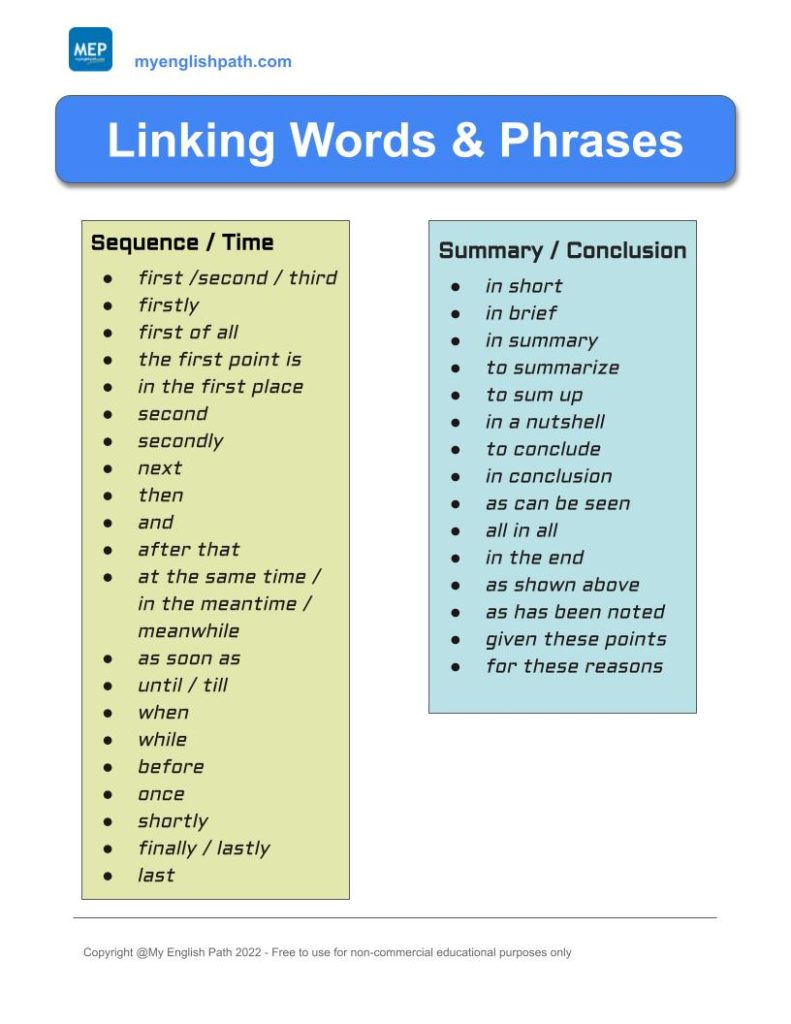
Sequence / Time
- first /second / third, etc.
- firstly
- first of all
- the first point is
- in the first place
- second
- secondly
- next
- then
- and
- after that
- at the same time / in the meantime / meanwhile
- as soon as
- until / till
- when
- while
- before
- once
- shortly
- finally
- lastly
- last
Examples:
- To make nice cupcakes at home, follow these instructions carefully. First, preheat oven to 180°C/160°C . Before you start preparing the ingredients, line muffin or mini-muffin pans with paper cases. Using an electric mixer, beat butter, vanilla and sugar in a small bowl until light and fluffy. Then, add eggs, 1 at a time, beating after each addition . When the mixture is ready, transfer it to a large bowl, and stir in half the flour and half the milk. Repeat with remaining flour and milk until combined. After that, fill muffin liners with batter. Bake for 10 to 12 minutes. Stand cakes in pans for 2 minutes. Finally, transfer cakes to a wire rack to cool.
Summary / Conclusion
- in short
- in brief
- in summary
- to summarize
- to sum up
- in a nutshell
- to conclude
- in conclusion
- as can be seen
- all in all
- in the end
- as shown above
- as has been noted
- given these points
- for these reasons
These phrases are used to introduce a summary or conclusion of points or discussion.
- The agenda had not been shared, a number of participants arrived late, and there were no refreshments. In brief, the meeting was a disaster.