
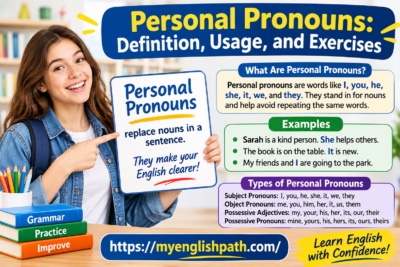
Personal pronouns are an essential part of English grammar. They help us communicate clearly, avoid repeating nouns, and make sentences shorter and more natural. Whether you are a beginner or an advanced English learner, understanding personal pronouns will improve your speaking, writing, and reading skills.
In this lesson from My English Path, you will learn the definition of personal pronouns, their different types, how to use them correctly, and some simple exercises to test your knowledge.
Table of Contents
What Are Personal Pronouns?
Personal pronouns are words that replace nouns referring to people, animals, or things. Instead of repeating someone’s name or the name of an object, we use a pronoun.
For example:
Sarah is a student. She studies English.
John is my brother. He lives in London.
The book is interesting. It is about history.
My friends are helpful. They always support me.
The words she, he, it, and they are personal pronouns because they replace nouns.
Types of Personal Pronouns
Personal pronouns are divided into two main groups: subject pronouns and object pronouns.
1. Subject Pronouns
Subject pronouns perform the action in a sentence. They include:
I, you, he, she, it, we, they.
Examples:
I speak English every day.
You are a good student.
He plays football.
She works in a hospital.
We enjoy learning grammar.
They live in the United States.
2. Object Pronouns
Object pronouns receive the action of a verb or follow a preposition.
Me, you, him, her, it, us, them.
Examples:
My teacher helps me.
I called him yesterday.
She invited us to her party.
The children listened to them.
How to Use Personal Pronouns Correctly
To use personal pronouns correctly, remember these simple grammar rules:
Use I when talking about yourself as the subject.
Use me when referring to yourself as the object.
Use he for a male person and she for a female person.
Use it for an animal or thing when appropriate.
Use we when talking about yourself and other people.
Use they when referring to multiple people or things.
For example, say “She likes music,” not “Her likes music.”
Personal Pronouns: Practice Exercises
Choose the correct personal pronoun to complete each sentence.
1. Sarah is my sister. _____ is a teacher.
A. He
B. She
C. They
2. My brother and I are students. _____ study English.
A. We
B. Us
C. They
3. I saw Peter yesterday. I talked to _____.
A. he
B. his
C. him
4. The children are playing outside. _____ are happy.
A. They
B. Them
C. We
5. My mother loves _____ very much.
A. I
B. me
C. my
Answer Key: 1-B, 2-A, 3-C, 4-A, 5-B.
For more grammar practice, visit the English Grammar Exercises section and try the Pronouns Quiz.
Conclusion
Personal pronouns are important for building correct and meaningful English sentences. Learning the difference between subject and object pronouns will help you avoid common grammar mistakes and communicate more confidently.
Keep practicing with examples, reading exercises, and online quizzes. Visit My English Path to discover more English grammar lessons, helpful explanations, and interactive exercises.
You can also explore our Complete Guide to Pronouns for additional examples and explanations.