


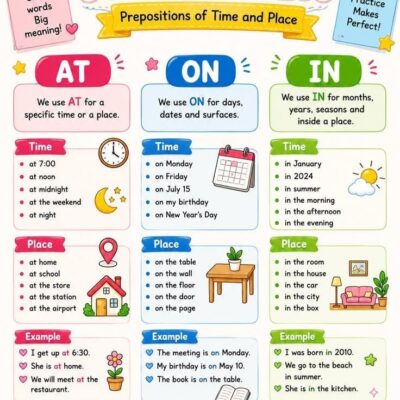
Prepositions are an important part of English grammar. They help us understand the relationships between people, places, objects, and time. Words such as in, on, at, under, between, and behind are common prepositions used in everyday conversations.
Learning how to use prepositions correctly can improve your speaking, writing, and reading skills. In this guide, you will learn the main types of prepositions, important grammar rules, and useful examples.
Table of Contents
1. What Are Prepositions in English?
A preposition is a word that shows the relationship between a noun or pronoun and another word in a sentence.
Prepositions often describe:
Place: Where something is located.
Time: When something happens.
Direction: Where someone or something is going.
Movement: How someone or something moves.
Examples:
The book is on the table.
She lives in London.
We have an English lesson at 9 o’clock.
The children walked through the park.
In these sentences, the bold words are prepositions.
2. Types of Prepositions in English
There are several types of prepositions. Understanding their uses will help you choose the correct word in different situations.
A. Prepositions of Time
Prepositions of time tell us when something happens. The three most common prepositions are in, on, and at.
In: Used with months, years, seasons, and longer periods.
My birthday is in July.
She was born in 2005.
We travel in summer.
On: Used with days and dates.
I have an exam on Monday.
The meeting is on November 10.
We usually visit our grandparents on weekends.
At: Used with specific times.
The class starts at 8:00 AM.
I go to bed at midnight.
We meet at lunchtime.
B. Prepositions of Place
Prepositions of place explain where someone or something is located.
Common examples include:
In: The keys are in the bag.
On: The phone is on the desk.
Under: The cat is under the chair.
Behind: The car is behind the house.
Between: The bank is between the school and the supermarket.
Next to: My house is next to the hospital.
C. Prepositions of Movement
Prepositions of movement describe how someone or something moves from one place to another.
Examples include:
To: She goes to school every morning.
Into: He walked into the room.
Across: They walked across the street.
Through: The train passed through the tunnel.
Towards: The dog ran towards its owner.
Out of: She walked out of the building.
D. Prepositions of Direction
These prepositions show the direction of movement or the destination of an action.
Examples:
Walk towards the main entrance.
The children ran up the stairs.
He drove down the hill.
Turn around the corner.
3. Important Rules for Using Prepositions
Here are some useful rules to remember:
Rule 1: Use “in” for enclosed spaces.
Example: The children are playing in the garden.
Rule 2: Use “on” for surfaces.
Example: Your notebook is on the table.
Rule 3: Use “at” for specific locations and points.
Example: She is waiting at the bus stop.
Rule 4: Some adjectives are followed by specific prepositions.
Examples:
Interested in music.
Good at mathematics.
Afraid of spiders.
Proud of her achievements.
Rule 5: Some verbs are followed by specific prepositions.
Examples:
Listen to music.
Depend on your parents.
Believe in yourself.
Wait for the bus.
Remember that preposition combinations are often learned through practice.
4. Common Preposition Mistakes
English learners sometimes confuse prepositions, especially in, on, and at.
Here are some common mistakes:
| Incorrect | Correct |
|---|---|
| I was born on 2000. | I was born in 2000. |
| She is good in English. | She is good at English. |
| We arrived to the airport. | We arrived at the airport. |
| He is interested on science. | He is interested in science. |
Paying attention to these differences will help you use English more naturally.
5. Prepositions Exercises with Answers
Test your understanding by choosing the correct preposition.
1. The book is _____ the table.
A. in
B. on
C. at
2. My birthday is _____ December.
A. in
B. on
C. at
3. She is good _____ mathematics.
A. in
B. at
C. on
4. We arrived _____ the airport early.
A. at
B. in
C. on
5. The cat is hiding _____ the bed.
A. over
B. under
C. between
Answer Key:
B — on
A — in
B — at
A — at
B — under
Conclusion
Prepositions are essential for communicating clearly in English. They help describe time, place, movement, and relationships between different parts of a sentence.
Start by learning common prepositions such as in, on, at, under, and between. Then practice using them in everyday sentences.
The more you read, write, and practice, the more confident you will become.
Continue improving your English grammar and vocabulary with more lessons and exercises at MyEnglishPath.com.