


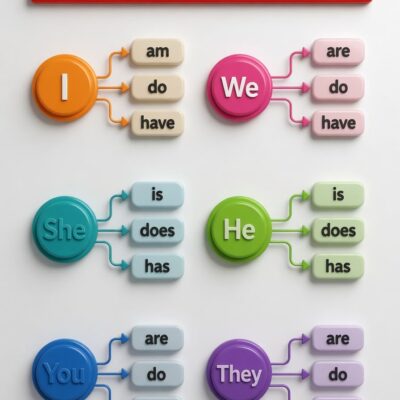
Pronouns are an important part of English grammar. They help us avoid repeating the same nouns in sentences and make our speaking and writing clearer and more natural. For beginners, understanding pronouns is an essential step toward learning English successfully.
In this guide, you will discover the main types of pronouns, their basic grammar rules, and easy examples to help you use them correctly.
Table of Contents
What Are Pronouns in English?
A pronoun is a word that replaces a noun or refers to a person, place, thing, or idea.
For example:
Sarah is a student. She studies English.
Tom has a new car. It is very beautiful.
John and Mike are friends. They play football together.
Instead of repeating names or nouns, we use pronouns to make sentences shorter and easier to understand.
Types of Pronouns in English
There are several types of pronouns that beginners should learn.
1. Personal Pronouns
Personal pronouns refer to people or things. They can be subjects or objects in sentences.
Examples:
I like English.
She is my sister.
They are playing football.
My teacher helped me.
Common personal pronouns include I, you, he, she, it, we, and they.
2. Possessive Pronouns
Possessive pronouns show ownership. They replace nouns to avoid repetition.
Examples:
This book is mine.
That house is ours.
The blue bag is hers.
The choice is yours.
Common possessive pronouns include mine, yours, his, hers, ours, and theirs.
3. Reflexive Pronouns
Reflexive pronouns are used when the subject and the object of a sentence refer to the same person or thing.
Examples:
I taught myself English.
She prepared herself for the exam.
They enjoyed themselves at the party.
Examples include myself, yourself, himself, herself, itself, ourselves, and themselves.
4. Demonstrative Pronouns
Demonstrative pronouns point to specific people or things.
The main demonstrative pronouns are this, that, these, and those.
Examples:
This is my favorite book.
That is your classroom.
These are my friends.
Those are beautiful flowers.
5. Interrogative Pronouns
Interrogative pronouns are used to ask questions.
Common examples include who, whom, whose, which, and what.
Examples:
Who is your teacher?
What is your name?
Which is your favorite subject?
Whose is this pencil?
Important Rules for Using Pronouns
To use English pronouns correctly, remember these simple rules:
Use subject pronouns before verbs when they perform the action.
Use object pronouns after verbs or prepositions.
Use possessive pronouns to show ownership without repeating nouns.
Make sure pronouns agree with the nouns they replace in number and meaning.
Use reflexive pronouns when the subject and object refer to the same person or thing.
Conclusion
Learning pronouns in English is an important step for beginners who want to improve their grammar, writing, and speaking skills. By understanding personal, possessive, reflexive, demonstrative, and interrogative pronouns, you can build clearer and more natural sentences.
Practice using different pronouns every day, and continue exploring English grammar lessons and exercises to develop your language skills.