
Learning comparative adjectives is an important step toward speaking and writing English more naturally. One useful adjective is “narrow,” which describes something that has a small width or limited space. When comparing two streets, rooms, paths, or even ideas, we can use the word “narrower.”
In this guide, you will learn how to form the comparative of narrow, understand its meaning, and practice using it in everyday situations.
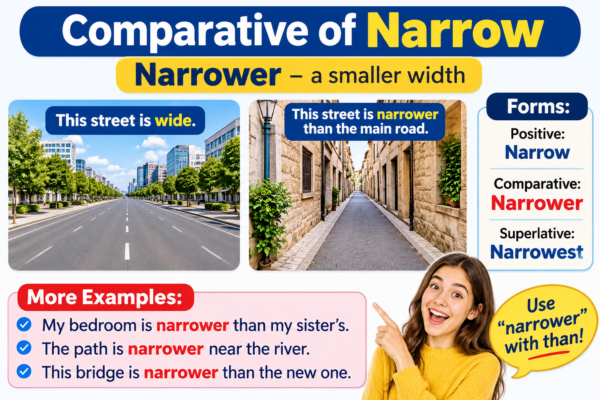
Table of Contents
What Is the Comparative Form of Narrow?
The comparative form of narrow is narrower. We use it to compare the width of two things or describe something that has less space or a more limited range than another thing.
Here are the three forms:
Positive: Narrow
Comparative: Narrower
Superlative: Narrowest
For example:
This street is narrow.
This street is narrower than the main road.
This is the narrowest street in the neighborhood.
The comparative adjective “narrower” is commonly followed by “than” when we want to identify the second thing in a comparison.
Real-Life Examples of Narrower
Understanding grammar becomes easier when you connect it with everyday experiences. Here are some practical examples.
1. Comparing Streets and Roads
Imagine walking through two streets in a town. One street has enough space for several cars, while the other is much smaller.
Example: The street near my house is narrower than the main road.
This sentence compares the widths of two streets.
2. Comparing Rooms
People often compare rooms when choosing an apartment or arranging furniture.
Example: My bedroom is narrower than my sister’s bedroom.
This means that the bedroom has less width, although it might still be longer or larger in another dimension.
3. Comparing Shoes
Shopping is another situation where comparative adjectives are useful.
Example: These shoes are narrower than the pair I bought last month.
Here, “narrower” describes the width of the shoes.
4. Comparing Bridges and Paths
When walking, cycling, or driving, the width of a path can make a difference.
Example: The old bridge is narrower than the new bridge.
This sentence tells us that the old bridge has less width than the new one.
5. Comparing Ideas and Choices
The word “narrower” can also describe something that is not physical. It can refer to a limited range of topics, choices, or interests.
Example: Her research has a narrower focus than his research.
In this context, “narrower” means that her research covers a smaller or more specific subject area.
How to Use Narrower Correctly
To form the comparative of narrow, add “-er” to the adjective:
Narrow + er = Narrower
Remember these useful grammar tips:
Use “narrower” when comparing two things.
Use “than” when mentioning the second item in the comparison.
Use “narrowest” when identifying something with the least width in a group.
Avoid combining “more” with “narrower” in standard comparative sentences.
For example:
Incorrect: This road is more narrower than that road.
Correct: This road is narrower than that road.
You can also explore our guide to Comparative of Narrow: Real-Life Examples for Learners for additional explanations and examples.
Practice Sentences for English Learners
Read these sentences and notice how the comparative adjective is used:
This hallway is narrower than the one upstairs.
The path becomes narrower near the river.
My new desk is narrower than my old desk.
This entrance is narrower than the main entrance.
We chose a narrower topic for our class project.
Try writing five sentences of your own using “narrower.” You can describe objects in your home, streets in your neighborhood, or subjects you study at school.
For additional grammar practice, visit MyEnglishPath.com to explore more English-learning resources and improve your vocabulary, grammar, and sentence structure.
Conclusion
The comparative of narrow is narrower, and it helps us compare the width or scope of two things. Whether you are describing streets, rooms, shoes, bridges, or ideas, using “narrower than” can make your English more accurate and natural.
Practice these real-life examples regularly to build confidence with comparative adjectives and strengthen your everyday English communication skills.