
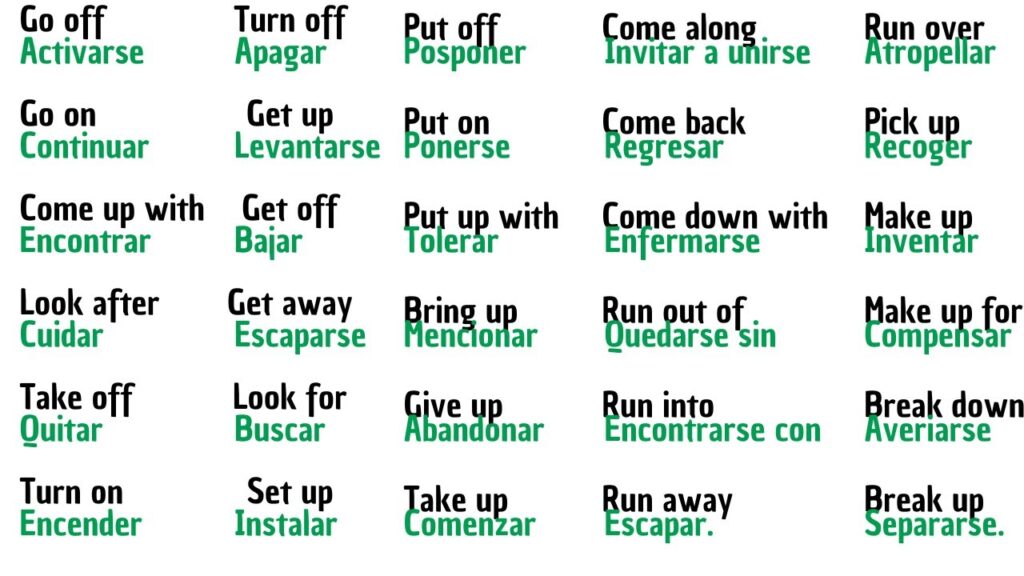
Today, we will examine a prevalent verb form in English known as phrasal verbs. There are more than 4,000 verbs that belong to this category. Are you familiar with their usage? In this episode, we will introduce this type of verb and assist you in understanding how and why English speakers utilize them. In upcoming episodes, we will provide additional information regarding the various types of phrasal verbs.
Phrasal verbs in history
Our narrative commences during a time when other languages, such as French and Old Norse, began to exert influence on Middle English. This era began with the invasion of the British Isles in 1066 by William the Conqueror, the Duke of Normandy.
In Middle English, small particles, or prefixes, were added before verbs to alter their meanings.
One such example that remains in use is ‘for’ as seen in ‘forlorn.’ The term ‘lorn’ in Old English signified ‘lost.’ By adding the prefix ‘for,’ the term ‘forlorn’ was created, which conveys the meaning of being lonely or sad. Over time, these prefixes began to fade away, with some reemerging as adverbs, which are separate words that follow the verb.
William Shakespeare, a renowned playwright of the era, produced numerous works between 1589 and 1613. His writings, composed in Early Middle English, encompass over 5,744 phrasal verbs.
Formal language and phrasal verbs
In Modern English, phrasal verbs are predominantly employed in informal contexts. This trend can be traced back to the period when French had a significant impact on English. English speakers perceived French words, or those derived from Latin, as more refined or cultured. When aiming for a more formal tone, one can substitute a single word of Latin or French origin for most phrasal verbs. For instance, the phrasal verb ‘look over’ can be replaced with ‘review.’
As English learners are well aware, everyday conversations in English are rarely formal. Therefore, feel free to incorporate phrasal verbs when engaging in English in casual situations.
Another general observation regarding phrasal verbs is that British English employs different ones compared to American English. Historically, British English speakers utilized phrasal verbs less frequently than their American counterparts. Presently, the Oxford English Dictionary notes that…
The composition of phrasal verbs
Let us begin by examining the fundamental composition of phrasal verbs. A phrasal verb consists of a phrase containing two or more words: a verb along with a preposition or adverb, or both. An illustration can be found in the following sentence:
I looked up my cousin’s phone number.
In this case, the verb is ‘look,’ and ‘up’ serves as the adverb. The phrasal verb ‘look up’ signifies ‘to research’ or ‘search for.’
Certain phrasal verbs permit an object to interrupt the phrase.
I didn’t know the number, so I had to look it up.
In this instance, the pronoun ‘it’ represents the object, ‘number.’
Conversely, other phrasal verbs must remain intact. For example, you can express that you care for someone using the phrasal verb ‘look after,’ as demonstrated in:
I looked after Andy’s dog while he was on vacation.
However, it is incorrect to say, ‘I looked his dog after while he was on vacation.’
The first two categories of phrasal verbs we examined consist of two words. The subsequent category comprises three words. For instance,
I put up with the noise of my neighbor’s party because I knew it was his birthday.
In this case, the phrasal verb ‘put up with’ conveys the meaning of ‘tolerate.’ The verb ‘put’ is followed by the particle ‘up’ and the prepositional phrase ‘with + object’ (the noise).
These phrasal verbs necessitate direct objects. We cannot state, ‘I put up because I knew it was his birthday.’
Now, let us consider some examples.
Carrie asked me to help out with the cooking.
In this scenario, we can replace the phrasal verb ‘help out’ with a single verb, ‘assist.’
Nevertheless, we must retain the preposition ‘with’ when we rephrase the sentence, as follows:
Carrie asked me to assist with the cooking.
Another three-part phrasal verb is ‘look up to,’ which means ‘admire.’ We can express this as,
She looks up to her sister.
In this case, ‘sister’ serves as the direct object. We cannot reposition ‘sister’ elsewhere in the sentence, as in ‘She looks her sister up to.’
Identifying a phrasal verb
Learners may experience confusion due to the existence of verb and preposition combinations that resemble phrasal verbs. How can one distinguish between them?
A standard verb + preposition combination possesses two meanings. Consider the sentence,
I looked up at the sky.
Here look means view and up means in a higher direction. On the other hand, a phrasal verb has a single meaning. We saw look up earlier, meaning “research.”
Another test is whether you can move the object. You cannot say, “I looked the sky up,” with the meaning “I gazed upwards at the sky.”
So if you want to test whether a combination of words is a phrasal verb, ask these questions:
Can I substitute a single word for a two-word phrase?
The answer should be “yes.”
Can I remove the direct object in a three-word phrase?
The answer should be “no.”
In the next Everyday Grammar, we will take a closer look at phrasal verbs that can separate from the adverb.